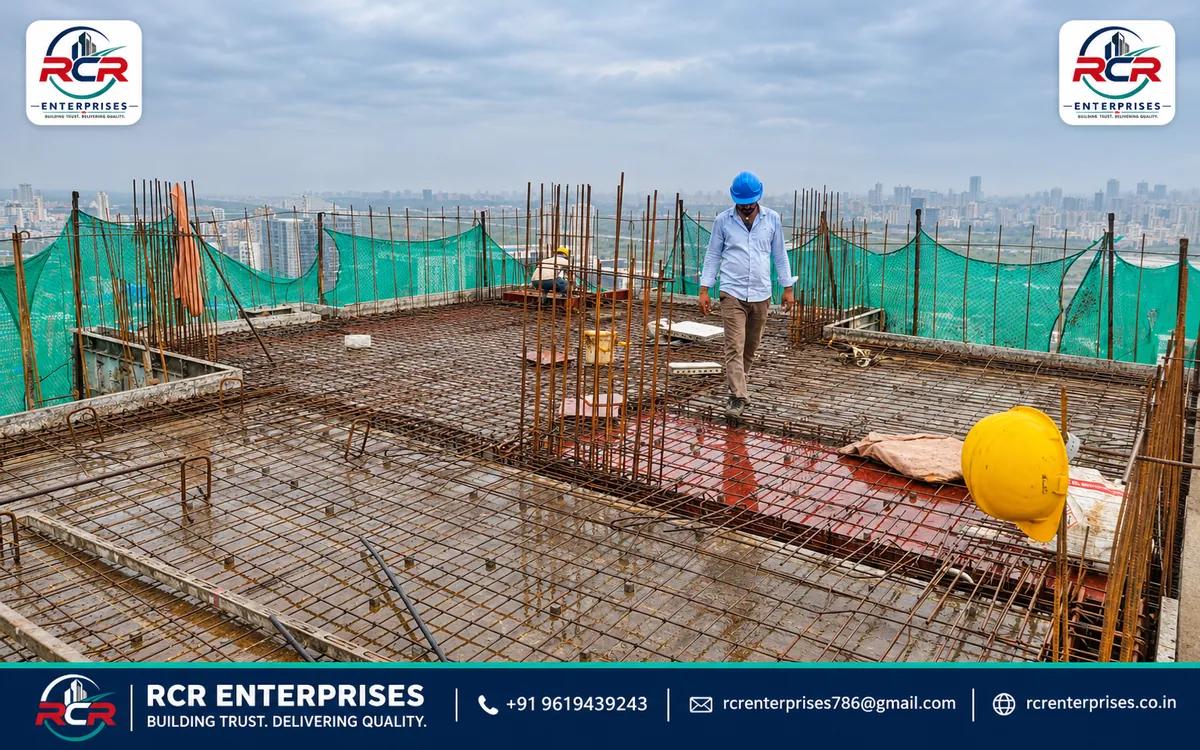
Once the transit mixer discharges concrete onto the slab deck, there is zero room for modification. Any forgotten plumbing sleeve, shifted rebar cage, or unbraced shuttering prop can result in disastrous structural defects or costly core cutting later. Here is the exact 15-point quality assurance checklist our site engineers execute before clearing any pour across sites in Mumbai, Pune, and Thane.
The Master 15-Point Pre-Pour Checklist
Part A: Shuttering & Scaffolding Stability
- Level & Camber Check: Verify overall deck level using water levels or auto-level instruments. Check if a positive camber (1 in 500) has been provided at the center of long spans.
- Prop Verticality (Plumb): Ensure all telescopic iron props are 100% vertical. Leaning props have drastically reduced axial load capacities and can buckle under wet concrete weight.
- Base Plate Bracing: Verify that props rest on solid, unyielding ground or timber sole plates—never directly on loose soil or hollow blocks.
- Joint Sealing: Check all plywood seams. Joints must be sealed with high-adhesion PVC foam tape to prevent slurry leaks.
- Release Agent Coating: Confirm non-staining shuttering oil has been applied evenly to plywood before laying rebar.
Part B: Reinforcement & Steel Detailing
- Bar Diameter & Spacing: Verify main reinforcement and distribution bars against structural blueprints using a measuring tape.
- Adequate Cover Blocks: Ensure 20mm/25mm concrete cover blocks are tied at a maximum frequency of 1 block per square meter.
- Chair Spacers for Top Steel: Confirm that top negative moment bars and cranked bars are supported by rigid rebar chairs (minimum 12mm dia) to prevent sagging when workers step on them.
- Lap Lengths & Staggering: Verify lap lengths ((50 imes ext{dia})) and ensure laps in bottom beam bars occur near the supports, while laps in top bars occur at mid-span.
- Seismic Hook Angles: Ensure all beam stirrup hooks are bent to 135 degrees with adequate extensions into the core.
Part C: MEP Sleeves, Conduits & Final Cleaning
- Fan Hooks & Conduit Tie-Downs: Ensure MS/PVC junction boxes and fan boxes are tied down securely to rebar so vibration does not dislodge them.
- Plumbing Sleeves: Verify sunken slab drop boundaries and confirm all drain sleeves (for toilets and balconies) are cast-in with PVC pipe collars.
- Debris Air Cleaning: Blow out all sawdust, wire scraps, cigarette butts, and paper with an air blower or water jet before placing concrete.
- Vibrator & Backup Availability: Ensure at least 2 mechanical needle vibrators (including a diesel or petrol backup in case of power failure) are tested and ready.
- Gangway Boards: Ensure timber walking planks are positioned across the rebar mesh so concrete carriers do not step directly on reinforcement.
Prioritize uncompromising quality on your construction site. Discover how RCR Enterprises executes flawless pours across our Slab Casting Services and RCC Contracting Work.
Planning a Civil or RCC Project?
Talk to our master engineers and get direct item-rate or turnkey quotations.